



Art in Black II: Five Visions Born from Shadow

Black is a threshold. A place where forms loosen, meanings melt, and the subconscious begins to speak. In this second chapter of Art in Black, five surrealist visions rise from the dark—each one shaped by fluid time, shifting space, and the quiet glow of symbols that refuse to stay still.
These artworks do not merely depict darkness; they grow from it, revealing how shadow can be a garden, a doorway, a mirror, a distortion, and a dream.
1. A Garden Growing in the Dark
Time softens in this piece—literally. Clocks droop like overripe fruit, their faces slipping into the soil of the subconscious. Eyes bloom between the organic forms, watching, remembering, witnessing the slow unfurling of inner worlds.
The composition feels alive, as if the darkness itself is fertile. The melting clocks echo Dalí, but here they become seeds of transformation rather than symbols of decay. The flowing shapes suggest a landscape that is constantly reshaping itself, a garden where perception grows wild and untamed.
This artwork whispers that even in darkness, something is always taking root.
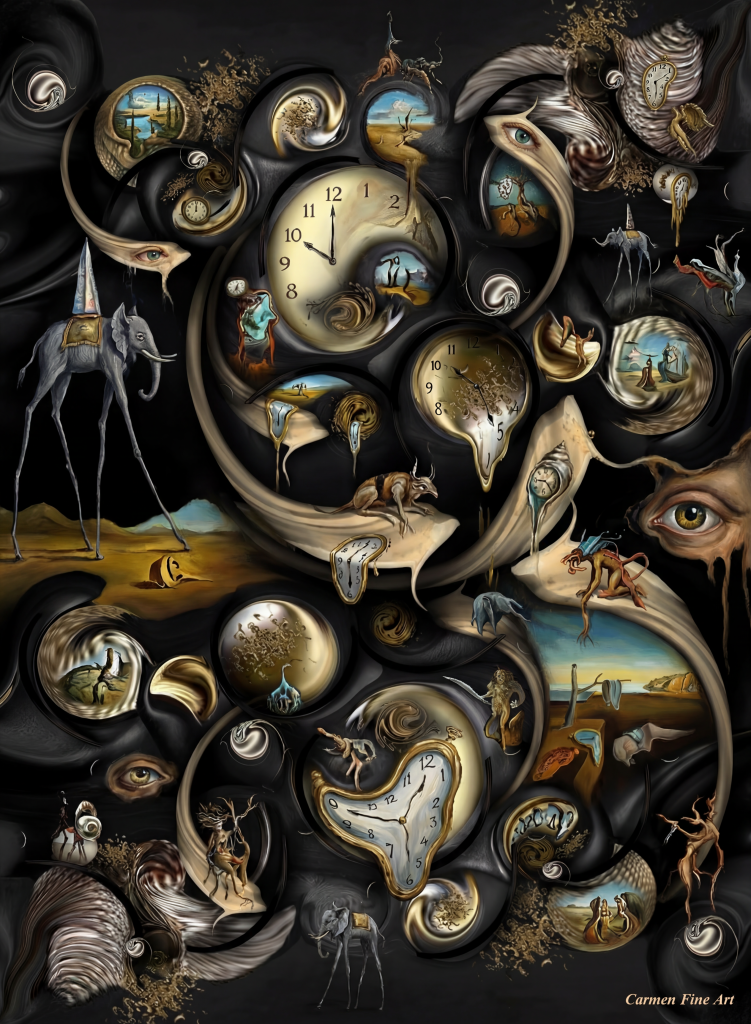
2. Fragment of Interfering Space
This painting fractures reality into impossible pieces. Floating keys drift through the air like unanswered questions. Doors open into nowhere. Human forms stretch, liquefy, and dissolve into the surrounding void.
The melting clocks return, but here they are not gentle—they are disruptive, bending the logic of the scene. Space folds in on itself, refusing to obey the rules of gravity or geometry.
The result is a dreamscape where objects interfere with one another’s meaning, where symbols overlap and distort, where the subconscious rearranges the world with no regard for order.
It is a portrait of a mind in motion—restless, curious, unbound.

3. Flowers of Earth
Organic forms swell and twist in this biomorphic composition, creating a landscape that feels both alive and unsettling. The shapes resemble roots, tendrils, petals, and organs all at once—beautiful, grotesque, and strangely tender.
The palette and structure evoke early surrealist explorations of the body as landscape, the earth as organism. Layers overlap like geological strata, each one hinting at something buried or blooming beneath.
This artwork is a reminder that nature is not always gentle. Sometimes it is strange, primal, and full of secrets.
4. Still Life with Darkened Energy
Gravity dissolves in this dreamlike still life. Objects melt, hover, and twist into impossible forms. Clock-like elements appear again, but here they feel ghostly—symbols of time slipping away, or perhaps time refusing to exist at all.
The composition radiates a quiet tension. Nothing is stable. Nothing is certain.
The molten shapes and illogical arrangements create an atmosphere of uncanny stillness, as if the scene is holding its breath. It is a still life not of objects, but of energy—dark, fluid, and alive beneath the surface.

5. The Autumnal Dream
A woman in profile anchors this ethereal composition, her realism contrasting with the swirling golden forms that surround her. The gold glows like liquid light against the deep black background, creating a dramatic interplay of shadow and radiance.
The swirling elements feel like thoughts, memories, or seasons passing around her. She remains calm, contemplative, almost timeless.
This artwork captures the moment between change and acceptance—the quiet pause before transformation. It is autumn rendered as emotion: luminous, fleeting, and full of introspective warmth.

Closing Reflection: When Darkness Becomes a Language
These five artworks continue the journey begun in Art in Black, revealing how darkness can be more than a backdrop—it can be a medium of transformation. In shadow, time melts. Space bends. Symbols awaken. Figures emerge from gold and silence.
Surrealism thrives in these liminal spaces, where the subconscious becomes visible and the impossible becomes intimate.
In this series, black is not emptiness. It is potential—a place where imagination grows roots, branches, and entire worlds.
